
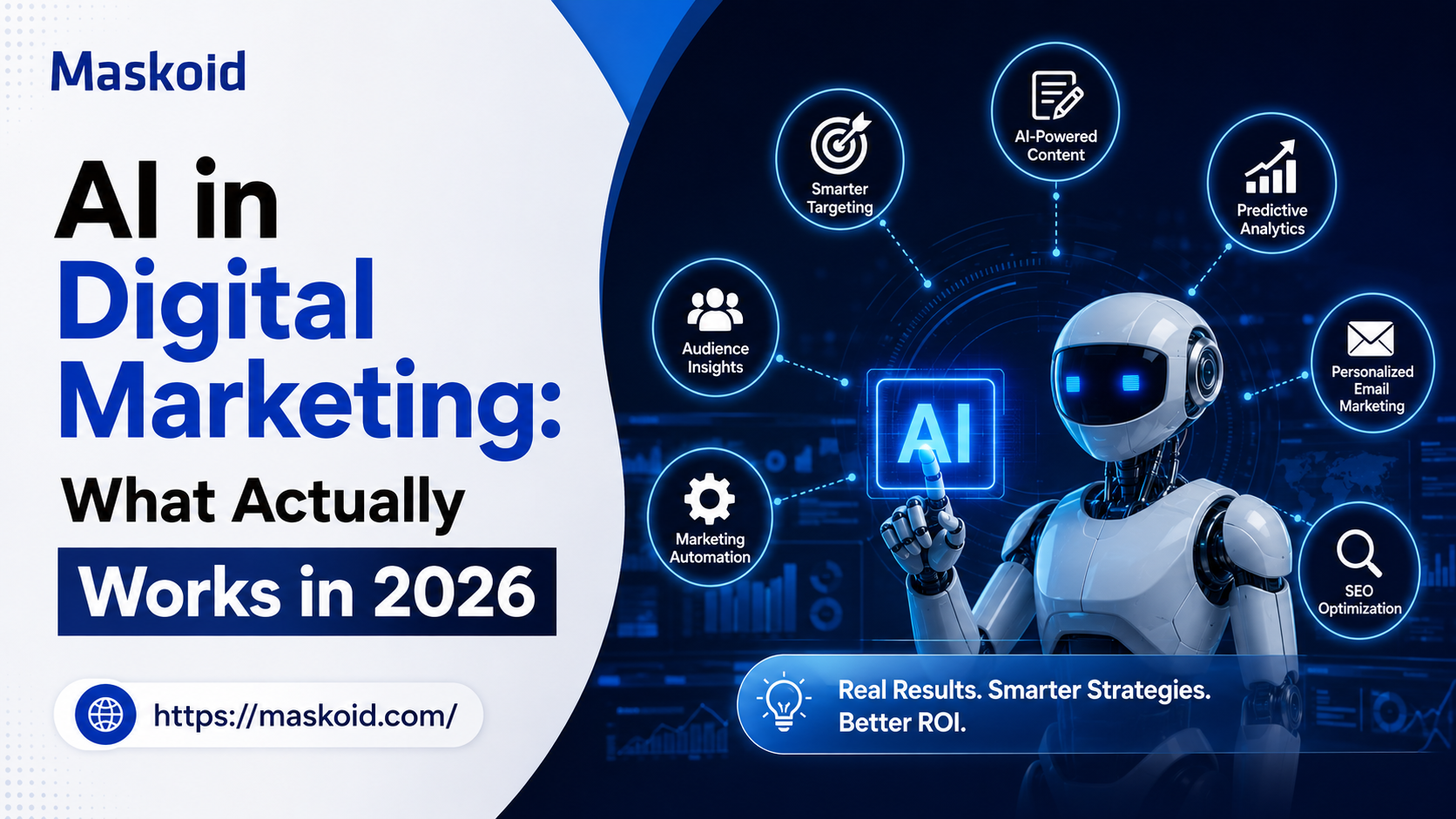
AI in Digital Marketing: What Actually Works in 2026

AI is changing how businesses find customers, understand audiences, create content, and improve marketing performance. But the real value of ai in digital marketing isn’t about replacing marketers or adding more tools to the stack. It’s about using technology to handle repetitive, data-heavy tasks while people focus on strategy, creativity, and decisions that actually move the business forward. In 2026, the companies getting the most from AI aren’t necessarily using the most advanced software. They’re using the right tools for the right problems, measuring what works, and keeping human judgment at the centre of the process. Here’s what AI can genuinely do for modern marketing and where the hype falls short.
What AI Can Really Do for Your Marketing?
Strip away the buzzwords and ai in digital marketing comes down to something fairly simple: software that spots patterns in customer behavior faster than a person could, and then acts on those patterns sorting audiences, adjusting bids, drafting copy, answering a support question at 2am.
It doesn’t replace the marketer’s job. It replaces the part of the job nobody enjoyed anyway digging through last month’s numbers trying to guess why engagement dipped on a Tuesday. The strategy, the voice, the actual creative decisions? Still a person’s call. AI just does the grunt work faster and, often, more accurately than a tired analyst at 6pm on a Friday.
Where the Benefits Actually Show Up?
Not all of the hype holds up, but some of it genuinely does.
Targeting gets sharper because the software can cross-reference browsing habits, past purchases, and engagement all at once, something that would take a human analyst days to piece together manually. Personalization stops being a nice idea and becomes something you can actually pull off across ten thousand contacts instead of ten. Content gets a faster first draft, though and this part matters; it only stays good if someone with an actual sense of the brand’s voice goes back and fixes it.
Automated follow-ups catch the customer who abandoned their cart without anyone lifting a finger. Chatbots mean someone browsing at midnight isn’t left waiting until 9am for an answer. And maybe the biggest shift: decisions start getting backed by “here’s what actually happened” instead of “I think this worked,” which matters a lot more once a marketing budget has to answer to someone with a spreadsheet of their own.
The Tools Nobody Uses Alone
Here’s something that surprised me when I started paying attention: almost nobody uses one all-in-one AI platform. Most teams stitch together two or three tools, each doing one job well: a content tool for first drafts, an SEO tool for keyword gaps, a chatbot for after-hours questions, a bidding tool that adjusts spend mid-campaign.
That patchwork approach isn’t a workaround. It’s the actual strategy. Nothing on the market does everything competently, so trying to find the one tool that solves every problem usually wastes more time than it saves.
Why Strategy Matters More Than AI Tools?
Buying tools is the easy part. Having effective AI marketing strategies is where most businesses actually fall short.
Grouping customers by what they actually do, not just their age and location tends to produce messaging that lands instead of messaging that gets ignored. Predictive models can flag a customer who’s about to churn before they actually leave, which gives someone a chance to fix it. Mapped-out customer journeys mean a new signup doesn’t just vanish into the void after the welcome email.
Ad spend gets reallocated toward whatever’s actually converting, mid-campaign, instead of waiting for a weekly report. Chat-based engagement fills the gap outside office hours. And one blog post can quietly become five social posts once AI handles the tedious repurposing work.
None of this works if it’s just tools stacked on top of each other with no plan behind them. The businesses seeing real returns from AI for digital marketing aren’t running the most software, they’re running a few tools with an actual point to each one.
Social Media Is Where You Can See It Happening
If you want to watch AI’s effect on marketing in real time, social media is the place to look. Content planning gets noticeably sharper when the software can point at what’s already worked and suggest a next move instead of a blind guess. Audience insight stops being “we have 12,000 followers” and starts being “our audience is actually most active at 9pm on Thursdays, doing something completely different than we assumed.”
Social listening picks up brand mentions the moment they happen instead of someone scrolling hashtags for an hour hoping to catch something. Caption drafts get a head start though the good ones still need a person to punch them up, because AI captions on their own tend to sound like, well, AI captions. Posting times get dialed in so content actually reaches people instead of disappearing into a feed nobody’s checking.
This is exactly where AI-powered digital marketing works best: AI handles the data-heavy lifting, while a person makes the judgment calls a spreadsheet can’t make. It’s a partnership, not a handoff.
What’s Next for AI-Powered Marketing?
Prediction models are only going to get better as they’re trained on richer data. Personalization is moving past email subject lines into nearly every touchpoint website copy, and creative, the works. Generative tools will keep speeding up how fast content gets produced, but the businesses that stand out won’t be the ones publishing the most AI output, they’ll be the ones adding something to it that a machine can’t.
Chatbots are going to keep sounding less like chatbots. Customer journeys will get better at anticipating what someone needs before they ask. And as AI reshapes how search itself works, the way content gets structured to stay visible is going to keep shifting under everyone’s feet.
The constant through all of it: human review matters more, not less, precisely because it’s getting rarer.
How to Measure the Impact of AI in Marketing?
Using AI is only valuable when it contributes to measurable marketing outcomes. Businesses should track whether AI is improving metrics such as conversion rates, customer engagement, cost per acquisition, lead quality, content performance, and campaign efficiency. Comparing results before and after implementing an AI solution can reveal whether the technology is actually delivering value or simply adding another layer to the marketing process. The focus should remain on business results rather than the number of AI tools being used.
How to Build an Effective AI Marketing Workflow?
The best results come when AI becomes part of an organised marketing workflow rather than being used as a standalone solution. Businesses can use AI to analyse data, identify opportunities, generate initial content, segment audiences, automate repetitive tasks, and support campaign optimisation. Marketers can then review the output, apply brand knowledge, and make strategic decisions. This approach creates a workflow where technology improves efficiency while human expertise maintains quality, consistency, and relevance.
Conclusion
AI in digital marketing is no longer just a future concept; it has become a practical part of how businesses plan, create, analyse, and improve their marketing efforts. From understanding customer behaviour and automating repetitive tasks to creating personalised experiences and making faster, data-driven decisions, AI can deliver real value when used with the right strategy. In 2026, the businesses seeing the strongest results are not simply using more AI tools, they are combining ai in digital marketing with human creativity, judgement, and continuous testing. At Maskoid Technologies, we believe the future of marketing is not AI replacing people, but AI helping marketers work smarter, move faster, and create strategies that genuinely drive business growth.
Frequently Asked Questions
What is the Difference Between AI and Traditional Automation?
Traditional automation follows predefined rules and instructions to complete repetitive tasks. AI uses machine learning and data analysis to identify patterns, make predictions, and support decisions. For example, automation sends scheduled emails based on set triggers, while AI can analyze customer behavior and recommend personalized content or offers.
What is AI in Digital Marketing?
AI in digital marketing refers to using artificial intelligence technologies to analyze data, understand customer behavior, personalize experiences, and automate marketing activities. Marketers use AI for content creation, customer segmentation, predictive analytics, chatbots, ad optimization, SEO research, and personalized recommendations.
How do Marketers Use AI?
Marketers use AI to improve efficiency and make data-driven decisions. Common applications include generating and optimizing content, analyzing customer data, personalizing campaigns, predicting customer behavior, optimizing advertising campaigns, automating customer support, researching keywords, and analyzing marketing performance.