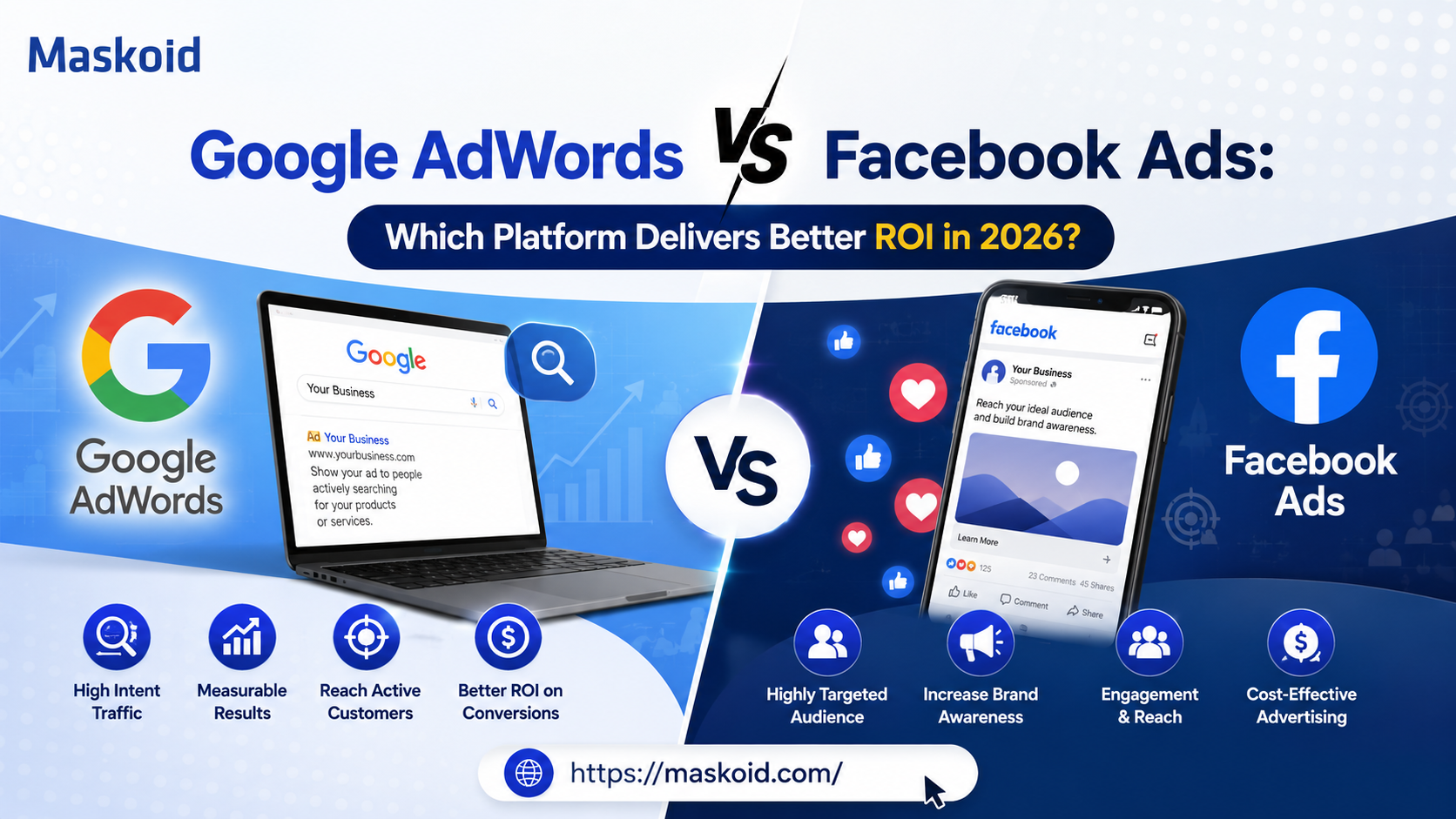
Google AdWords vs Facebook Ads: Which Platform Delivers Better ROI in 2026?

Google AdWords vs Facebook Ads: Which Platform Delivers Better ROI in 2026?
Google adwords vs facebook ads – if you’ve typed some version of this into Google recently, you’re not alone. It’s probably the most common question we get asked in client meetings, and there’s a good reason for that. Pick the wrong platform and you’ll burn through your budget without much to show for it. Here’s the short version: google adwords goes after people who are already searching for what you sell, while Facebook Ads puts your product in front of people before they’ve even started looking. Both can work. It just depends on what you’re selling and who you’re selling it to.
What Is the Real Difference Between Google AdWords and Facebook Ads?
Google AdWords (now Google Ads) targets intent. Someone searches “best running shoes Vadodara,” and your ad appears right when they’re ready to buy. Facebook Ads targets interest and behavior instead. It shows your product to people scrolling their feed who haven’t even thought about buying yet, but match your ideal customer profile.
Here’s the thing — one is reactive, the other is proactive. Google catches demand. Facebook creates it. Neither is “better” in isolation; they simply solve different problems in a marketing funnel.
Key Takeaway: Google Ads captures existing demand through search intent, while Facebook Ads generates new demand through interest-based targeting.
Which Platform Offers Better ROI for E-Commerce Brands?
This is probably the question we hear the most from e-commerce clients, and honestly, the answer comes down to what you’re selling and how much it costs. Cheap, impulse-buy products — say ₹500 to ₹1,500 fashion or beauty items — tend to do really well on Facebook. Scroll-stopping visuals and video creativity push people to buy on the spot, often before they’ve even finished thinking about it.
Bigger purchases work differently though. Furniture, electronics, real estate — these need more thought. People research before they buy, so Google Ads tends to catch them right when they’re ready to make a decision.
We’ve seen this play out in the numbers too. A 2025 WordStream benchmark report found Google Search ads convert at around 4.4% on average, compared to roughly 2.5% for Facebook Ads across industries. But here’s the catch — Facebook’s cost-per-click usually runs 30-40% lower than Google’s. So if you’re running high-volume campaigns, that lower cost can more than make up for the dip in conversion rate.
Key Takeaway: Google Ads tends to win on conversion rate. Facebook Ads tends to win on cost-efficiency and reach.
How Do Google Ads and Facebook Ads Compare for B2B Lead Generation?
We’ve run B2B campaigns for SaaS clients where Google Ads pulled in fewer but far more qualified leads. LinkedIn often outperforms both here, but between our two contenders, Google Ads usually edges ahead for B2B because decision-makers actively search for solutions.
Facebook still has a role though. It’s excellent for top-of-funnel brand awareness and retargeting website visitors who didn’t convert the first time. Think of it as the nurture engine, not the closer.
A practical example: one of our fintech clients generated 40% more qualified demo requests through Google Search than through Facebook Lead Ads over a 90-day test — but Facebook retargeting recovered 18% of abandoned form-fills that Google alone couldn’t touch.
Key Takeaway: Google Ads drives higher-intent B2B leads; Facebook Ads strengthens retargeting and brand recall.
What Should You Consider Before Choosing a Platform in 2026?
Let’s be honest — most advertisers underestimate how much budget actually matters here. If you’ve got less than ₹50,000 a month to work with, don’t split it evenly between Google and Facebook. You’ll end up with mediocre results on both instead of great results on one. Figure out where your buyer is in their journey, then pick accordingly.
A few things we always ask clients before recommending a platform:
- What’s your product’s price point? Cheaper, impulse-buy items tend to do well on Facebook. Bigger, more thought-out purchases usually convert better on Google.
- How long is your sales cycle? Quick decisions suit Google’s search intent. Longer cycles benefit from Facebook’s nurturing and retargeting.
- Do you have solid creative assets? Facebook lives or dies on visuals and video. If your creative team can’t keep up, this platform will burn budget fast.
- How niche is your audience? For tight, specific B2B segments, Google’s search targeting often outperforms Facebook’s interest-based approach.
Here’s what we’ve noticed after years of running campaigns: it’s rarely about choosing one platform over the other. The businesses that get the best ROI are the ones that use both, but in sequence — Facebook to build awareness, Google to close the sale.
Key Takeaway: Let your product type, budget, and sales cycle guide the decision — not gut feeling or which platform you personally prefer.
Conclusion
If there’s one thing to take away from all this, it’s that the google adwords vs facebook ads question doesn’t have a one-size-fits-all answer — your product, budget, and customer behavior decide that for you. The smarter move is to test both on a small scale, watch what the data actually tells you, and put more money behind whichever one delivers. If you want help figuring out your google adwords split without the guesswork, Maskoid Technologies can walk you through it. Get your approach right now, and the results will follow through 2026 and beyond.
Frequently Asked Questions
Do Google Ads work better than Facebook Ads?
Google Ads isn’t universally better — it depends on your goal. Google Ads works better for capturing active buyer intent, since people are already searching for what you sell. Facebook Ads works better for building awareness and reaching people who haven’t started looking yet. Most businesses see the best ROI using both together, not one over the other.
Which is cheaper, meta Ads or Google Ads?
Meta Ads (Facebook and Instagram) are generally cheaper per click, often 30-40% lower than Google Ads. However, “cheaper” doesn’t always mean better value — Google Ads usually converts at a higher rate, so the actual cost per sale can end up similar or even lower depending on your industry and offer.
What are the disadvantages of Google Ads?
Google Ads can get expensive fast in competitive industries like insurance, legal, or real estate, where cost-per-click sometimes exceeds ₹100. It also requires ongoing keyword research and bid management to avoid wasted spend. Since it only targets people already searching, it’s not ideal for building brand awareness among cold audiences.
What is the cheapest way to run ads?
For most small businesses, Facebook and Instagram Ads offer the cheapest entry point, with campaigns starting from as low as ₹500-₹1,000 per day. Using detailed audience targeting, retargeting website visitors, and testing multiple creatives before scaling also helps keep costs down across both Google and Facebook.
Which platform is best for running Ads?
There’s no single “best” platform — it depends on your product and audience. Google Ads works best for high-intent, search-driven purchases, while Facebook Ads works best for visual products and impulse buying. The right choice comes down to testing both platforms with a small budget first, then scaling what performs.